Equitable Distribution in Florida Divorce
Equitable Distribution in Florida Divorce: What It Really Means
Divorce changes every part of daily life, and one of the most stressful questions is what will happen to the home, savings, vehicles, and debts. Florida uses a system called equitable distribution to divide marital property. Many people hear the word equitable and assume it always means equal, but that is not exactly how the law works.
Equitable distribution focuses on fairness based on the unique facts of each marriage. Courts look at contributions, financial circumstances, and the needs of children before deciding who receives specific assets and responsibilities. Understanding this process early can reduce fear and help you make better decisions.
Families in St. Petersburg, Clearwater, Largo, Seminole, and Pinellas Park often worry that the court will not see the full picture of their sacrifices and challenges. The law provides a framework so judges can consider more than simple math. With preparation and guidance, you can protect what matters most.
What Is Equitable Distribution in Florida
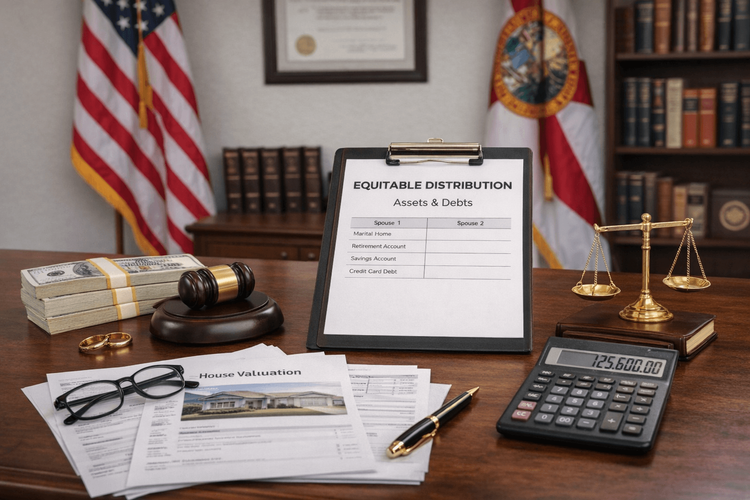
Equitable distribution is the legal method Florida courts use to divide marital assets and marital debts during divorce. Marital property generally includes anything acquired during the marriage, regardless of whose name appears on the title. This can include homes, retirement accounts, business interests, vehicles, and even credit card balances.
Nonmarital property is treated differently. Assets owned before the marriage or received individually as gifts or inheritance may remain separate if they were not mixed with marital funds. Determining what is marital and what is nonmarital is often the first major step.
The goal is a fair division, not necessarily a fifty-fifty split. Judges have discretion to adjust the outcome when equal division would be unjust. Every case is evaluated on its own facts.
How Florida Courts Evaluate Equitable Distribution
Florida law lists several factors judges must consider before dividing property and debts. These factors allow the court to look at the real story of the marriage rather than relying on rigid formulas.
Courts examine the contribution each spouse made to the marriage, including caring for children and managing the household. A parent who left the workforce to raise children provided value even without a paycheck.
The economic circumstances of both spouses are important. Judges review income, earning ability, health, and future needs. The length of the marriage also matters because longer marriages often create deeper financial interdependence.
Interruptions to education or careers are weighed carefully. If one spouse delayed schooling so the other could advance professionally, the court may adjust distribution to reflect that sacrifice.
Judges also consider whether certain assets should remain intact. A family business, professional practice, or retirement account may lose value if split, so one spouse might keep the asset while the other receives something of equal worth.
Special attention is given to the marital home when children are involved. The court may allow a parent and child to remain in the residence if it is financially feasible and in the best interest of the child.
Waste or dissipation of assets can affect the outcome. Spending large sums on nonmarital relationships or gambling close to the divorce filing may lead to an unequal division.
Finally, the court can consider any other factor necessary to reach a just result. This flexibility is what makes equitable distribution different from a strict formula system.
Common Mistakes People Make
- Assuming everything will automatically be split in half
- Hiding assets out of fear or anger
- Ignoring debts because only one name is on the account
- Relying on online calculators instead of real legal advice
- Failing to gather statements from the date of separation
- Transferring property before speaking with a lawyer
- Overlooking the tax impact of retirement accounts
Practical Next Steps
- Collect statements for all bank accounts, credit cards, and loans from separation and filing dates
- Obtain recent values for real estate and major assets
- Create a list of property owned before the marriage
- Track any unusual spending during the last two years
- Prepare a monthly budget showing real living expenses
- Keep copies of business records if you or your spouse is self employed
If you are ready for guidance, you can schedule a consultation to review your specific situation and create a plan.
Pinellas County and Tampa Bay Considerations
Courts serving St. Petersburg, Clearwater, Largo, Seminole, and Pinellas Park handle a wide range of families, from military households to small business owners and long-term retirees. Local economic conditions and housing values often influence how assets are viewed.
Many Tampa Bay families own homes purchased years ago that have increased significantly in value. Determining how much of that growth is marital can be complex. Retirement accounts tied to large employers in the region also require careful analysis.
Mediation is commonly encouraged in Pinellas County to help spouses reach agreements without trial. Understanding equitable distribution beforehand makes mediation more productive and less emotional.
E-E-A-T and Reliable Guidance
Information about divorce on the internet can be confusing and sometimes outdated. Every family has unique finances, children, and goals. General articles cannot replace personalized legal advice.
The attorneys at Barnett & Woolums focus on Florida family law and work daily with equitable distribution issues. Our role is to explain options in plain language so clients can make informed choices.
This article provides educational information only. It does not create an attorney-client relationship and should not be viewed as a promise of any specific result. Laws change and courts evaluate each case individually.
Frequently Asked Questions
Is equitable distribution always equal in Florida?
No. Equitable means fair under the circumstances. Many cases result in equal division, but judges can order an unequal split when the legal factors justify it.
Who decides what property is marital?
The court decides if spouses cannot agree. Documentation showing when and how an asset was acquired is critical to that decision.
Are debts divided the same way as assets?
Yes. Marital debts are included in equitable distribution even if only one spouse signed for the loan or credit card.
Can I keep my house after divorce?
Possibly. The court considers financial feasibility, the best interest of children, and whether one spouse can buy out the other or offset the value with different assets.
What if my spouse wasted money before filing?
Intentional dissipation of assets can lead to an unequal division. Evidence such as bank records and transaction histories is important.
Do gifts and inheritances get divided?
Generally no, if they were kept separate. Mixing those funds with marital accounts can change the analysis.
How long does equitable distribution take?
The timeline varies based on cooperation, complexity of assets, and court schedules in Pinellas County.
Should I settle or go to trial?
Settlement gives more control and privacy. Trial may be necessary when spouses cannot reach fair terms.
Can we agree to our own division?
Yes. Courts usually approve agreements that are voluntary and not unconscionable.
When should I speak with a lawyer?
As early as possible, ideally before major financial decisions are made.
Moving Forward With Confidence
Divorce is difficult, and financial uncertainty can make emotions even heavier. Equitable distribution is designed to bring balance and fairness, not to punish either spouse. With accurate information and experienced guidance, the process becomes more manageable.
Barnett & Woolums helps families throughout Pinellas County understand their rights and protect their future. You can call our office at 727-525-0200 to discuss your concerns and learn the next steps.
About the Author
Callie M. Krueger
Need Legal Assistance?
If you're facing a family law matter, our trusted attorneys are here to help. Contact us today for a consultation to discuss your specific situation.